Scheuermann’s Disease
Video Testimonials
Scheuermann’s Disease
What is Scheuermann’s disease?
What causes Scheuermann’s disease?
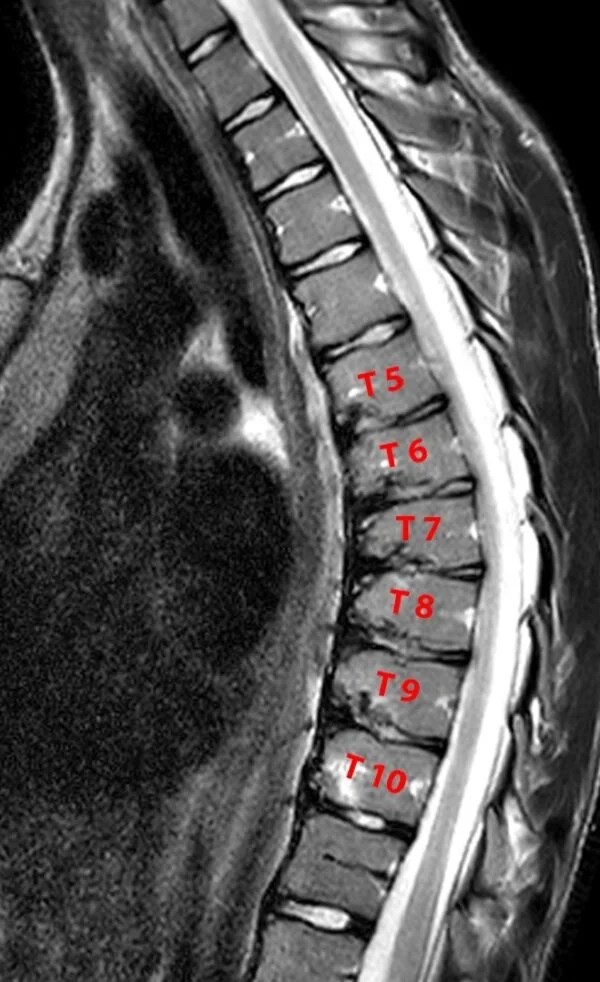
It is caused by abnormal development of the bones and/ or ligaments of the spine. This leads to wedging of the spinal bones [“vertebrae”].
How does Scheuermann’s disease manifest?
Pain is the hallmark of this disease. In addition, sometimes, patients can develop a hunchback deformity of the back. This problem is noted only if the disease affects the upper or mid back region and is extremely rare in afflictions of the lower back. Rarely, a severe hunchback deformity can affect the spinal cord function leading to weakness in the lower limbs or clumsiness while walking. This is again most commonly noted in afflictions of the mid back rather than upper back regions.
How is Scheuermann’s disease treated?
Pain is the hallmark of this disease. In addition, sometimes, patients can develop a hunchback deformity of the back. This problem is noted only if the disease affects the upper or mid back region and is extremely rare in afflictions of the lower back. Rarely, a severe hunchback deformity can affect the spinal cord function leading to weakness in the lower limbs or clumsiness while walking. This is again most commonly noted in afflictions of the mid back rather than upper back regions.
What is the nature of surgery?
Is the surgery safe?
Rather than asking the question as to whether spine surgery is safe; it is more candid to ask as to what are the problems that a patient will face, if he undergoes surgery and what if he does not undergo surgery? What are the benefits a patient will have, if he undergoes surgery and what if he does not undergo surgery? Again, spine surgery is not like cosmetic surgery; i.e. it is not optional! Any learned, well-trained well-trained spine surgeon and spine specialist would offer spine surgery only if all other options are reasonably exhausted. This does not mean that spine surgery has no complications at all. Everything that we do in life carries some inherent risk. On a similar ground, spine surgery too has its own share of risks; but any learned, well-trained spine surgeon would offer spine surgery only if the benefits outweigh the risks by a factor of at least 10:1! Also, there have been a lot of advances in the field of spine surgery, which has rendered the knowledge contained in even 10-15 year old textbooks as obsolete! The advent of MRI for preoperative diagnostics has allowed the surgeon to rule out any problems within the spinal cord that might limit the surgical options. The advent of intraoperative imaging such as C-arm and computer-aided navigation has given a very safe option for inserting metal implants into the spine, thus improving the postoperative rehabilitation of these patients and also tremendously increasing the safety levels of these surgeries. The use of operating microscope allows for safe handling of neural tissues, minimizing neurotrauma. All this coupled with numerous scientific studies to study various factors to enhance the efficacy of spine surgery and we have a scenario, where the risks associated with spine surgery are significantly neutralized!
So, if you have a problem that genuinely requires surgery, there is no point in denying yourself the benefits of today’s medical advances! Discuss the details of your surgery with the best spine consultant in Bangalore and its attendant risks to quell any fears and to clear any and every doubt of yours! If you so desire, your consultant for spine or spine specialist can even arrange to give you references of patients who have undergone similar surgeries.